💃🏿‧ִֶָ𓂃 ࣪˖ ִִֶֶָ🥀་༘࿐TANGO SOLEMI╋━
ANTISOCIAL DANCE CLASSES
Antisocial Dance Classes invites you to rethink what it means to be “antisocial” — not as isolation, but as resistance. Through improvisation and somatic practices, we explore small acts of choice: moving closer or further away, saying yes or no, staying or leaving. Inspired by feminist and political perspectives, the class reclaims vulnerability and refusal as forms of agency. A space to listen to your impulses, question norms, and remain truthful to yourself in relation to others.
dance, workshop
WED 18.03.2026
6:00pm — 8:00pm
Mertonstr. 30, Bockenheim, Frankfurt am Main
The sessions are not subsidised and are offered on a donation basis. Donations start at 7€, with a recommended contribution of 15€, please give what you can. If money is tight, don’t hesitate to reach out — we will find a way to make it possible for you to join.
Email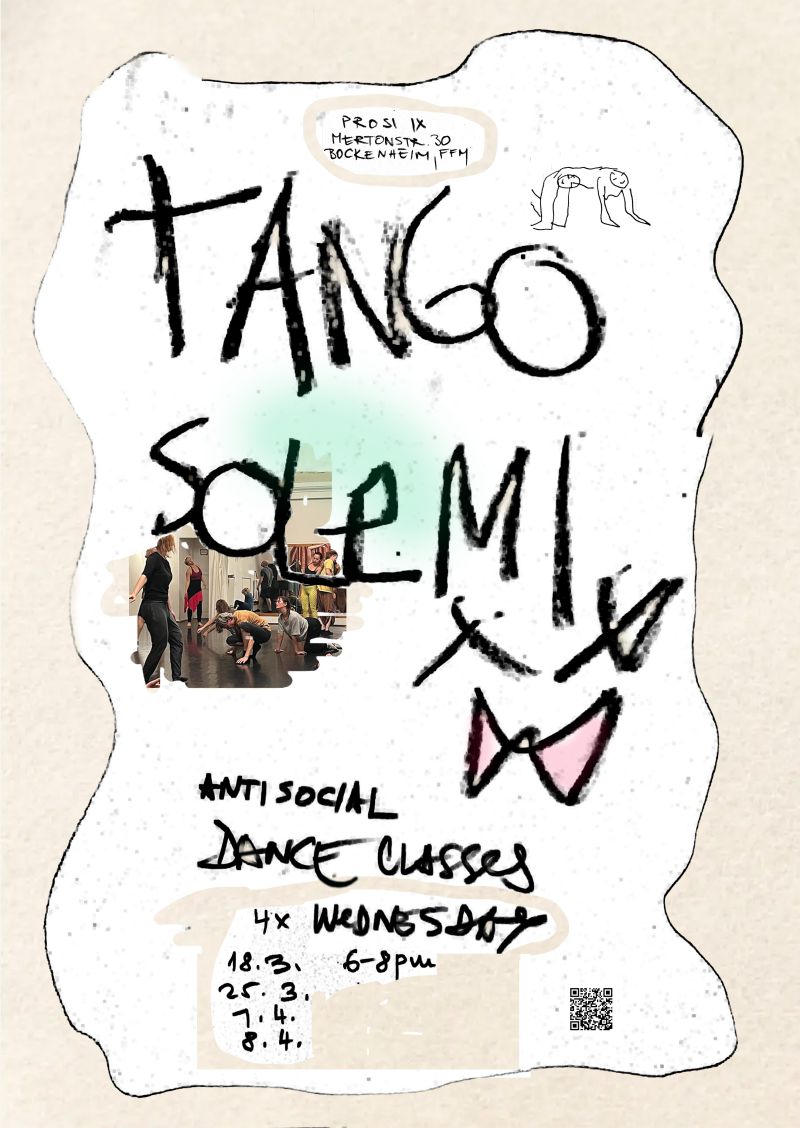
antisocial dance classes
Information on accessibility
In English, and in easy German
💃🏿‧ִֶָ𓂃 ࣪˖ ִִֶֶָ🥀་༘࿐tango solemi╋━ Antisocial Dance Classes
A Roma feminist lecturer Aldessa Georgiana once spoke about how Roma people are labeled “antisocial”—as those who cannot adapt to society. Yet the same society refuses to adapt to them, demanding integration into Western norms. She said: We want to be antisocial. Don’t force integration. Make change. Give us a voice. “Antisocial” was also a Nazi category—asozial—used to persecute Roma, Jewish, jobless, disabled, queer people, prostitutes, drinkers and others who did not conform. The word carries a history of exclusion and violence. So what might it mean to reclaim it? In a culture of compulsory sociability, stepping back can protect privacy, reduce toxic dynamics, and allow unconventional ways of living. Antisociality can become a refusal to conform. In this class, we explore what it means to be “antisocial” within a social space like dance. Instead of prioritizing rational behavior, we practice relational decision-making. Through improvisation and somatic scores, we rehearse small choices: moving toward or away, staying or leaving, saying yes or no. Dance becomes a space to listen to impulses, to notice fear or shame, and to ask whether what is coded in us can be decoded. Antisocial—not as isolation, but as the courage to remain truthful to oneself in relation to others.
Facilitator: Zuzana Žabková (1987, Košice) is an artist, dancer, and choreographer who explores the body as a prophetic apparatus, always in touch with something beyond itself. In her work, she often starts from a place of wounds, weakness, and brokenness, embracing these as holy strategies for survival. She is interested in somatic fiction and collective play structures that serve as laboratories for imagining and training new forms of social relations.
x