EMIGRANT SONGS
In Emigrant Songs, four performers weave voices, bodies, and threads into a shared landscape. As a camouflage net slowly takes shape, folk songs inspired by the region of Polissja / Palesse overlap, carrying fragments of home across borders. Between weaving and singing, they explore cultural camouflage and the quiet negotiations of migration — asking how a voice can stay present while searching for a place to belong.
dance, theatre, performance, workshop, dance/performance
THU 14.05.2026
7:00pm — 8:45pm
Gallus Theater, Kleyerstraße 15, 60326 Frankfurt
This performance takes place in an open, freely arranged space space. That is, there are chairs and cushions to sit on, distributed at various spots around the room, and you are also welcome to move freely around the room at any point during the show. At the centre of the evening is a shared activity: weaving a real camouflage net, which will be passed on to Ukrainian defence units after the performance. You are warmly invited to join in the weaving – or simply to watch. There is no obligation. Occasional gentle invitations to move/dance together will be offered, always with the possibility of participating in your own way or not getting involved altogether. Your presence – in whatever form – is warmly welcome.
Ticket needed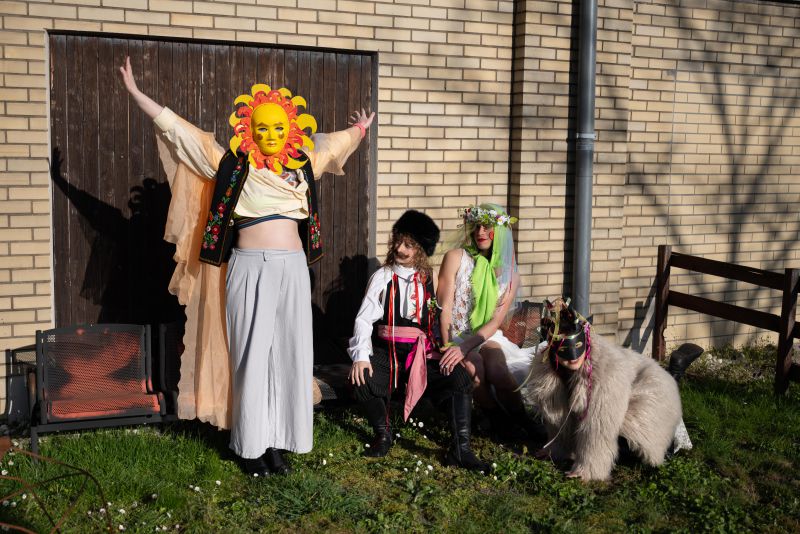
Four performers pose outdoors in front of a brick wall and a dark wooden gate, in bright sunlight. On the left, a figure stands with arms raised wide, wearing a yellow sun mask with flame-like petals, a cream-colored flowing garment, and an embroidered folk vest. In the center, a performer in a white shirt, a fur Cossack hat with curly hair, black breeches, boots, and a pink sash with colorful ribbons sits casually. Beside them, a figure in a white lace dress with a vivid green veil and a flower wreath crown looks on. On the right, a fourth performer crouches low, dressed in a shaggy animal-like fur costume and wearing a dark masquerade mask. Props including a metal fireplace grate and a wooden chair frame are scattered on the grass around them.
Information on accessibility
Wheelchair-accessible event room? (No steps or thresholds higher than 5 cm, doors at least 90 cm wide, wheelchair-accessible toilet, etc.)
Are there loud noises?
Loud music and singing
Are content notes provided for the audience in advance?
Further information regarding accessibility
Language Note: The primary languages of the performance are Ukrainian and Belarusian. Nevertheless, the work remains accessible through shared human experience, movement, and sound. No language skills are necessary to connect with the work. To support your experience, a brochure with translations of the song texts will be provided.
Polissja / Palesse is a region spanning the border of Ukraine and Belarus, where a cultural and linguistic commons exists, connecting Ukrainian and Belarusian despite imperial attempts to erase both languages and cultures.
In Emigrant songs, four performers gather fragments of this heritage, weaving their voices into a living, breathing archive. At the heart of the piece is the camouflage net — a mesh of fabric and stories, of (in)visibility and protection in the ongoing war. On stage, threads are knotted, hands move rhythmically, voices rise, and heels begin to stomp. How much do you blend in to stay safe? Cultural camouflage becomes an effort to weave oneself into new social fabrics — to soften one’s outline, to mask a presence, to disappear into the background. Migration turns into a constant dance between the desire to be heard and the necessity to dissolve into the landscape.
Between weaving and singing, hiding and revealing, the performers trace fragile ways of staying visible while searching for where their voices come from and where they might belong.
Initiated by Nastya Dzyuban, created and performed in collaboration between Nastya Dzyuban, Olen Mamai, Hanna Launikovich, Andrii Punko
Costume: Delphina O. Hennig
Woodwork and emotional support: Nice Kager
Folk singing transmission & guidance: Tetiana Illchenko, Dariia Bakalova and folk music group Bozhedary
Folklore research & guidance: Andrii Punko
Sound design: Hanna Launikovich
Technical support: Felix Schwarzrock
Big warm thanks to Bernhard Siebert, Frédéric de Carlo, René Alejandro Huari Mateus, Barbara Krzoska, Chiara Marcassa, Jenny Flügge, Florian Ackermann and Frankfurt Lab team, Ida Daniel and IX ProsoziTé collective, Natalia Shcherbina, Olena Bronnikova and other members of the Weaving group, Melika Moazeni, Fabian Schäfer and Mania collective, Halyna Oblonina, Polina Oblonina, Tetiana Saienko
Funded by Kulturamt Frankfurt, Gesellschaft Freunde internationales Theater Frankfurt. Supported by Hessian Theater Academy with postgraduate funding.